

 Posts
Posts


ICC '08 Update #2 (Tuesday, August 5)
Welcome back to the GvD Blog coverage of the 2008 International Conference on Creationism! We are now on Day Two of ICC (Tuesday), and it has proved to be even better than the first day! Today's coverage has more information, more session coverage, more pictures, and more interviews!
As promised, the following are more pictures of the vendor tables, and the huge amount of creation information. (below)
 Some of the vendors, The Creation Research Society has the blue table
 The Creation Ministries International table
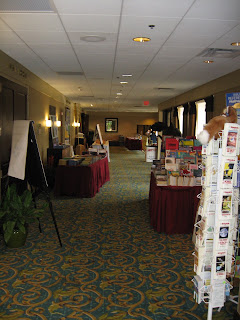 A long view of some of the vendor tables
The first session of Day Two of ICC '08 I attended was entitled "The "Eve" Mitochondrial Consensus Sequence" by Robert Carter. It was one of the most interesting talks I've attended yet! For those who don't know, the mitochondria (the cell's "powerhouse") has it's own set of DNA unique from the DNA in the nucleus. The mitochondrial DNA (commonly called mtDNA) is primarily passed from mother to child. MtDNA studies are commonly used by evolutionists and organizations like National Geographic to try and "prove" the "Out-of-Africa" model of evolution. As Carter pointed out, organizations like National Geographic commonly use only bits and pieces of the mtDNA from different people, then add on an evolutionary bias to the results. Essentially they could make any lineage they wanted only using little bits of mtDNA.
Instead of taking such an approach, Carter obtained about 2000 full-length mtDNA sequences. He then removed any sequences which had ever been called into question. He lined the remaining full 827 sequences up, and found that 83.9% of mtDNA is invariant throughout the samples. This will become important in a moment. He also found that of all the positions in the genome where it is variable, 43.8% are "private mutations" (only one individual had them). Lastly he found that 99% of all variation is found in almost no one.
If that seemed bit wordy or technical, the importance of the numbers is that there is almost no global variation in the mtDNA. This is a serious problem for evolution, as the mitochondria is under high selection pressure and mutations. If the mtDNA were millions of years old, there would be a wide range of differences in different people groups due to isolation. This research highly suggests a young age for mtDNA. What they eventually found out in their research that there are about 22 differences in the today's mtDNA from what the original woman Eve would have carried. This is easy to accomplish even in the about 150 generations since the flood. Sorry if I spent too much time on that talk, but I found it very interesting, especially now that many organizations are trying to push evolutionary ideas through mtDNA studies.
At 10:45 John Woodmorappe gave a talk entitled "Noah's Ark Design: Factoring Partial Composite Action." He talked about arguments commonly raised by skeptics about the design of the ark and whether is was truly seaworthy. I caught him at the last minute for a quick interview about his research (and what he really thinks about atheistic blogs and sites such as Talk.Origins).
(if audio does not load go to direct link)
(to download: right-click direct link and "save as")
Next I attended a talk by Dr. John Whitmore called (excuse the long name) "Using Suites of Criteria to Recognize pre-Flood, Flood, and post-Flood Strata in the Rock Record with Application to Wyoming (USA)." In essence, it was about trying to establish a relatively definitive area in the record where Flood deposits start and end. They established some criteria as to what would determine a Flood sediment. They showed a very interesting graph I wish I could get my hands on and post which had bars next to each criteria showing when (pre-Flood, Flood, post-Flood) these features would be most prevalent.
But I am overlooking two VERY important presenters today. Dr. Andrew Snelling presented two papers today on radiohalos in different types of rock, and their evidence of rapid burial and the Flood. Dr. John Baumgardner gave the closing lecture of the night (to a very large crowd) entitled "Catastrophic Plate Tectonics: A Mechanism for the Flood" (perhaps the most eye-opening talk of the conference). Why am I overlooking them? Well, I am only doing so temporarily, and you will not be disappointed. I have interviews with each of these widely-published and popular scientists, each of which will be posted tomorrow for the the final GvD Blog Update from the 2008 International Conference on Creationism (though there will be an overview article on the conference later).
But don't worry, to satisfy your interview-needing appetite I have an interview with Kevin Anderson, who yesterday (Monday, August 4) gave a great talk entitled "A Creationist Perspective of Beneficial Mutations in Bacteria." In it, he briefly explains how a creationist should approach beneficial mutations, and more! (audio and picture below)
(if audio does not load go to direct link)
(to download: right-click direct link and "save as")

Kevin Anderson (middle) talks with two men about various types of mutation
Thus concludes the second day of the GvD Blog coverage of the ICC '08. Tomorrow is the last day of the conference, and sure to have some excited talks! Come back tomorrow for more updates, session overviews, interviews, and more!
Happy Trails,
GvD Sam
As promised, the following are more pictures of the vendor tables, and the huge amount of creation information. (below)
 Some of the vendors, The Creation Research Society has the blue table
 The Creation Ministries International table
 A long view of some of the vendor tables
The first session of Day Two of ICC '08 I attended was entitled "The "Eve" Mitochondrial Consensus Sequence" by Robert Carter. It was one of the most interesting talks I've attended yet! For those who don't know, the mitochondria (the cell's "powerhouse") has it's own set of DNA unique from the DNA in the nucleus. The mitochondrial DNA (commonly called mtDNA) is primarily passed from mother to child. MtDNA studies are commonly used by evolutionists and organizations like National Geographic to try and "prove" the "Out-of-Africa" model of evolution. As Carter pointed out, organizations like National Geographic commonly use only bits and pieces of the mtDNA from different people, then add on an evolutionary bias to the results. Essentially they could make any lineage they wanted only using little bits of mtDNA.
Instead of taking such an approach, Carter obtained about 2000 full-length mtDNA sequences. He then removed any sequences which had ever been called into question. He lined the remaining full 827 sequences up, and found that 83.9% of mtDNA is invariant throughout the samples. This will become important in a moment. He also found that of all the positions in the genome where it is variable, 43.8% are "private mutations" (only one individual had them). Lastly he found that 99% of all variation is found in almost no one.
If that seemed bit wordy or technical, the importance of the numbers is that there is almost no global variation in the mtDNA. This is a serious problem for evolution, as the mitochondria is under high selection pressure and mutations. If the mtDNA were millions of years old, there would be a wide range of differences in different people groups due to isolation. This research highly suggests a young age for mtDNA. What they eventually found out in their research that there are about 22 differences in the today's mtDNA from what the original woman Eve would have carried. This is easy to accomplish even in the about 150 generations since the flood. Sorry if I spent too much time on that talk, but I found it very interesting, especially now that many organizations are trying to push evolutionary ideas through mtDNA studies.
At 10:45 John Woodmorappe gave a talk entitled "Noah's Ark Design: Factoring Partial Composite Action." He talked about arguments commonly raised by skeptics about the design of the ark and whether is was truly seaworthy. I caught him at the last minute for a quick interview about his research (and what he really thinks about atheistic blogs and sites such as Talk.Origins).
(if audio does not load go to direct link)
(to download: right-click direct link and "save as")
Next I attended a talk by Dr. John Whitmore called (excuse the long name) "Using Suites of Criteria to Recognize pre-Flood, Flood, and post-Flood Strata in the Rock Record with Application to Wyoming (USA)." In essence, it was about trying to establish a relatively definitive area in the record where Flood deposits start and end. They established some criteria as to what would determine a Flood sediment. They showed a very interesting graph I wish I could get my hands on and post which had bars next to each criteria showing when (pre-Flood, Flood, post-Flood) these features would be most prevalent.
But I am overlooking two VERY important presenters today. Dr. Andrew Snelling presented two papers today on radiohalos in different types of rock, and their evidence of rapid burial and the Flood. Dr. John Baumgardner gave the closing lecture of the night (to a very large crowd) entitled "Catastrophic Plate Tectonics: A Mechanism for the Flood" (perhaps the most eye-opening talk of the conference). Why am I overlooking them? Well, I am only doing so temporarily, and you will not be disappointed. I have interviews with each of these widely-published and popular scientists, each of which will be posted tomorrow for the the final GvD Blog Update from the 2008 International Conference on Creationism (though there will be an overview article on the conference later).
But don't worry, to satisfy your interview-needing appetite I have an interview with Kevin Anderson, who yesterday (Monday, August 4) gave a great talk entitled "A Creationist Perspective of Beneficial Mutations in Bacteria." In it, he briefly explains how a creationist should approach beneficial mutations, and more! (audio and picture below)
(if audio does not load go to direct link)
(to download: right-click direct link and "save as")

Kevin Anderson (middle) talks with two men about various types of mutation
Thus concludes the second day of the GvD Blog coverage of the ICC '08. Tomorrow is the last day of the conference, and sure to have some excited talks! Come back tomorrow for more updates, session overviews, interviews, and more!
Happy Trails,
GvD Sam


