
ICC '08 Update #3 (Wednesday, August 6)

Welcome readers to the final day of the ICC '08 coverage. It has been a long journey filled with late nights, quick food trips, and likely the most concentrated amount of creation science anywhere. This final ICC '08 coverage post will include more talk-overviews, more pictures, more interviews with great scientists, and once again... MORE! So without further adieu, let's jump headfirst into the Genesis vs Darwin Blog's last day covering the Sixth International Conference on Creationism!

Before we get to the session coverage, I would like to point out once again the diversity of creation organizations present at this conference. For instance, there were even two tables set up with creation materials in different languages. I have included a picture of some resources from one of the tables below.
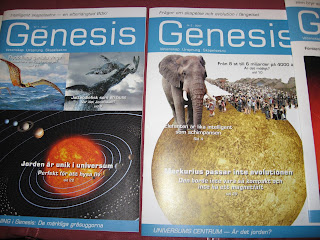
The other non-English table at the conference was filled with mostly Spanish reseources


The first talk of the day was entitled "Significance of Highly Discordant Radioisotope Dates for Precambrian Amphibolites in Grand Canyon, USA" and was presented by Dr. Andrew Snelling. It outlined the area where they obtained samples and presented the obtained dates for rocks when different radiometric dating techniques were used. For instance, a rock was 405.1 ± 10 ma (ma = million years) using one technique, and 2574.2 ±73 ma using another dating technique. That's a difference of about 2169.1 ma depending upon what dating technique you use. Ironically, the evolutionary date of the formation is supposed to be 1740-1750 ma. What is the evolutionist to do when neither of the clearly untrustworthy dating techniques agree with their dates?

Yesterday, Andrew Snelling also gave two talks on radiohalos, their significance, and their evidence for the Flood. I was able to catch Dr. Snelling for a quick interview about his talks, as well as about a presentation he is giving tonight for the conference closing called "The Creation Model: Its Past, Its Present, and Its Necessary Future." (below, followed by a picture)

(if audio does not load go to direct link)
(to download: right-click direct link and "save as")
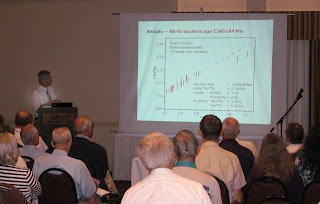


Andrew Snelling showing the results of some testing


I was also able to catch the very end of another talk at the same time entitled (once again, excuse the long name) "Analysis of Barry Hall's Research of the E. coli ebg Operon: Understanding the Implications for Bacterial Adaption to Adverse Environments" by Dr. Georgia Purdom. I wish I had heard more of this talk, as she talked about things such as Barry Hall's widely publicized research, as well as bacteria and their genes in different environments, etc. (picture below)


Georgia Purdom talks about adaptive mutations

At 10:15 I attended a talk by Dr. John Whitmore called "Rapid and Early Post-Flood Mammalian Diversification Evidenced in the Green River Formation." In the talk, they argued that the Green River Formation is a post-Flood deposit, rather than a Flood deposit, and also stressed the point that creationists need to agree upon parameters with which to decide when sediments were deposited. (picture below)

(left) Dr. John Whitmore talking about the Green River Formation
(right) Dr. Kurt Wise (co-writer of paper) took over for the Q&A session after the talk


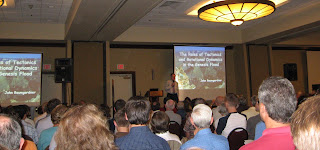
You may remember that in the last update I said that I had one more interview to share with you. Last night I got an interview with geophysicist Dr. John Baumgardner after his talk entitled "The Roles of Tectonics and Rotational Dynamics in the Genesis Flood" (my favorite, and more informative talk of the conference). Below is the final interview of the Genesis vs Darwin Blog coverage of ICC '08! (below, followed by a picture)

(if audio does not load go to direct link)
(to download: right-click direct link and "save as")


A wide view of Dr. Baumgardner during his talk and the crowd

The Sixth International Conference on Creationism has been an amazing experience. Hearing the latest in creation research presented by the top scientists in various fields, and even meeting many of these people that I have either heard of, seen videos of, or read books by, has truly been out-of-this-world. As Mark Looy (CCO and Co-Founder of Answers in Genesis) said to me in a conversation earlier about ICC, "It's almost like going to Disney Land [for a creationist]" but without, I might add, the fantasy!

So there you have it! The 2008 International Conference on Creationism, presented as only the GvD Blog can present it! Check out the various organizations and scientists mentioned in the updates, and get educated! If you want to see all of the interviews in one place, visit http://genesisvsdarwin.mypodcast.com. You can even download them to iTunes and your iPod from there! It would only be proper to end the ICC '08 coverage with a picture of yours truly being eaten by a ferocious dinosaur at the conference! (below)


Oh yeah, and check back soon for more posts on the GvD Blog!

Happy Trails,
GvD Sam

ICC '08 Update #2 (Tuesday, August 5)

Welcome back to the GvD Blog coverage of the 2008 International Conference on Creationism! We are now on Day Two of ICC (Tuesday), and it has proved to be even better than the first day! Today's coverage has more information, more session coverage, more pictures, and more interviews!

As promised, the following are more pictures of the vendor tables, and the huge amount of creation information. (below)


Some of the vendors, The Creation Research Society has the blue table

A long view of some of the vendor tables


The first session of Day Two of ICC '08 I attended was entitled "The "Eve" Mitochondrial Consensus Sequence" by Robert Carter. It was one of the most interesting talks I've attended yet! For those who don't know, the mitochondria (the cell's "powerhouse") has it's own set of DNA unique from the DNA in the nucleus. The mitochondrial DNA (commonly called mtDNA) is primarily passed from mother to child. MtDNA studies are commonly used by evolutionists and organizations like National Geographic to try and "prove" the "Out-of-Africa" model of evolution. As Carter pointed out, organizations like National Geographic commonly use only bits and pieces of the mtDNA from different people, then add on an evolutionary bias to the results. Essentially they could make any lineage they wanted only using little bits of mtDNA.

Instead of taking such an approach, Carter obtained about 2000 full-length mtDNA sequences. He then removed any sequences which had ever been called into question. He lined the remaining full 827 sequences up, and found that 83.9% of mtDNA is invariant throughout the samples. This will become important in a moment. He also found that of all the positions in the genome where it is variable, 43.8% are "private mutations" (only one individual had them). Lastly he found that 99% of all variation is found in almost no one.

If that seemed bit wordy or technical, the importance of the numbers is that there is almost no global variation in the mtDNA. This is a serious problem for evolution, as the mitochondria is under high selection pressure and mutations. If the mtDNA were millions of years old, there would be a wide range of differences in different people groups due to isolation. This research highly suggests a young age for mtDNA. What they eventually found out in their research that there are about 22 differences in the today's mtDNA from what the original woman Eve would have carried. This is easy to accomplish even in the about 150 generations since the flood. Sorry if I spent too much time on that talk, but I found it very interesting, especially now that many organizations are trying to push evolutionary ideas through mtDNA studies.


At 10:45 John Woodmorappe gave a talk entitled "Noah's Ark Design: Factoring Partial Composite Action." He talked about arguments commonly raised by skeptics about the design of the ark and whether is was truly seaworthy. I caught him at the last minute for a quick interview about his research (and what he really thinks about atheistic blogs and sites such as Talk.Origins).

(if audio does not load go to direct link)
(to download: right-click direct link and "save as")


Next I attended a talk by Dr. John Whitmore called (excuse the long name) "Using Suites of Criteria to Recognize pre-Flood, Flood, and post-Flood Strata in the Rock Record with Application to Wyoming (USA)." In essence, it was about trying to establish a relatively definitive area in the record where Flood deposits start and end. They established some criteria as to what would determine a Flood sediment. They showed a very interesting graph I wish I could get my hands on and post which had bars next to each criteria showing when (pre-Flood, Flood, post-Flood) these features would be most prevalent.

But I am overlooking two VERY important presenters today. Dr. Andrew Snelling presented two papers today on radiohalos in different types of rock, and their evidence of rapid burial and the Flood. Dr. John Baumgardner gave the closing lecture of the night (to a very large crowd) entitled "Catastrophic Plate Tectonics: A Mechanism for the Flood" (perhaps the most eye-opening talk of the conference). Why am I overlooking them? Well, I am only doing so temporarily, and you will not be disappointed. I have interviews with each of these widely-published and popular scientists, each of which will be posted tomorrow for the the final GvD Blog Update from the 2008 International Conference on Creationism (though there will be an overview article on the conference later).


But don't worry, to satisfy your interview-needing appetite I have an interview with Kevin Anderson, who yesterday (Monday, August 4) gave a great talk entitled "A Creationist Perspective of Beneficial Mutations in Bacteria." In it, he briefly explains how a creationist should approach beneficial mutations, and more! (audio and picture below)

(if audio does not load go to direct link)
(to download: right-click direct link and "save as")


Kevin Anderson (middle) talks with two men about various types of mutation

Thus concludes the second day of the GvD Blog coverage of the ICC '08. Tomorrow is the last day of the conference, and sure to have some excited talks! Come back tomorrow for more updates, session overviews, interviews, and more!

Happy Trails,
GvD Sam

ICC '08 Update #1 (Monday, August 4)

For those readers who are used to the science-and-scripture-filled lines of the GvD Blog, you will have to excuse the following short story...

I wake up to the radio playing from a clock that reads "4:00." The nearly five hour quest to reach ICC 2008 has begun! With only a few hitches (i.e. getting lost and accidentally driving away from Pittsburgh, nearly getting run over by traffic, etc.) we arrive at the Raddison hotel.

We're already late for our first session, so instead of checking out our room, we immediately make our way down the hallway on the left to the ICC Registration tables. Before I can even put on my name tag, I (literally) bump into famed creation geologist Andrew Snelling. That's when it really hit me: "I'm finally here at ICC, I am among the top creationist minds in the world."

As we were already late to the opening session, we browsed around the huge bookstore and many vendor booths set up about the conference hall. (pictured below)


(left) The Institute for Creation Research's table
(right) The back of one of the vendor rooms

The Answers in Genesis table, filled to the brim with creation resources
(note: there are even more vendor tables, I may post more pictures tomorrow)


Then came the next session. The very clever vendors made their tables so interesting that I was five minutes late to even the next session! I walk into "The Tectonics of Venus and Creation" by Robert Hill and... confusion. That's when I learned you have to be to the talks on time!

Thus ends the great introduction of the ICC '08 Quest... now on to the coverage of the talks I attended!


"The Tectonics of Venus and Creation" by Robert Hill covered the known geology of Venus and attempted to answer some questions about resurfacing and plate activity. One example he gave involved the RATE Team's research into accelerated nuclear decay possibly bringing about the catastrophic plate tectonics (causing the flood on earth). He proposed that the heat caused by the decay could have brought about the plate resurfacing on Venus.

At 3:15 we went to "The Creation of Cosmic Magnetic Fields" by Dr. Russ Humphreys, one of the most interesting talks I have heard yet. Rather than explain the whole talk in text and ruin the fun, why not let Dr. Humphreys himself explain it for you! I recently got an interview with Dr. Humphreys, a physicist, where he explained his talk, the history of his theory, and more! (below, followed by picture)

(note: audio may take a bit to load, depending on your connection speed)
(if audio takes too long to load, go to the direct link)
(to download: right-click direct link and "save as")


Sam and Dr. Humphreys talking magnetic fields, galaxies, helium diffusion, etc.


Later that night we went to a very interesting session by Dr. Steve Austin called "Understanding the Mudrock Revolution." Many of us have been taught that sediment slowly builds up on the bottom of rivers. In his talk, Dr. Austin showed why that is not always true, and gave many indications seen in rocks which indicate they were formed quickly, such as evidence of cross lamination, rather than the slow planar lamination of layers. But rather than steal all his steam, it would be easier to let him explain it. I also got an interview with Dr. Steve Austin after his talk, as well as a picture of the crowd during his talk. (both below)

(if audio does not load go to direct link)
(to download: right-click direct link and "save as")


The large crowd at Dr. Steve Austin's talk

That's all for Day One (or two if you count last night's opening talk as a whole day) of the 2008 International Conference on Creationism! Check back tomorrow for Day Two, sure to be just as amazing! Be on the look-out for more updates, more information, more pictures, more interviews, and... well... MORE!

Happy Trails,
GvD Sam

(note: this post was delayed due to problems with the audio software, lack of sufficient time, etc. Thus the Day Two post will be posted tomorrow.)

Creation Paper - The Fossil Record Supports Creation

GvD Sam

The Fossil Record Supports Creation

Two scientists climb their way to the top of the dusty hill. They look over the rocky edge into the bottomless ravine known as the Grand Canyon opening below them. Their awestruck eyes pan the geologic majesty as the sun’s bright orange glow cascades across the stream dotted with rafts far below them. The scientist on the right (an evolutionist) comments: “Incredible, a little bit of water and a lot of time created this entire canyon!” The scientist on the left (a creationist) comments: “Amazing, a little bit of time and a lot of water carved this entire canyon system!” Though perhaps a simple example, it represents the central issue in the current culture war. Which interpretation is correct, and why can’t we all agree?

Whether evolutionist or creationist, we all live on the same earth. Whether atheist or Christian, we all have the same universe, the same sun, the same geologic layers, the same fossils, etc. In short, all scientists, from humanist to Bible-believing, have the same evidence (observational science) [Reference 1]. How, then, do we have such a wide range of views and ideas? The evidence doesn’t speak for itself. Fossils never have tags on them telling you how old they are when you dig them up. The fossils exist in the present, and the fossil interpretations are about the past (historical science). The presupposition with which one approaches the evidence will drastically affect the conclusions. For instance, if you begin with the presupposition that the world is billions of years old and look at the fossil record, you will get a very different picture than one who starts with the presupposition that the world is only thousands of years old. As Patterson said, “No fossil, rock layer, or dating method can ever prove that evolution did, or did not, happen. The same is true for creation” [Reference 2]. Fossils can’t prove either evolution or creation, as the fossils themselves are interpreted within that worldview. But while the evidence is the same for all scientists, do observations correlate better with one theory rather than the other?

Darwin admitted in his book On the Origin of Species that the fossil evidence collected thus far did not correspond to his idea of evolution, though he predicted that his theory would eventually be shown in the fossils [Reference 3, p. 74-75]. So the question is whether the fossil evidence collected since Darwin’s time shown any different? While Darwin could claim that the lack of fossil support was due to an inadequate fossil collection, scientists cannot make such a claim today, as there are hundreds of millions of fossils in museums worldwide [Reference 3, p. 77]. With this immense amount of evidence, the adequacy of correlation should be obvious towards either evolution or creation. The Bible states in the Book of Genesis that God created different kinds of animals which could reproduce within their variety, but not change outside of it. Thus, if the Biblical creation account is true, we would expect to find different kinds of creatures (and perhaps variations within these kinds), and not a “clear-cut” evolutionary lineage (for instance, dogs coming from non-dogs, humans from non-humans, etc.). If evolution is true, the fossil record should be overflowing with intermediate forms between different creatures. It should show a clear progression from one form to the next, and so on [Reference 4, p. 417]. Yet the fossil record is eerily absent of any proven transitional forms or even a smooth evolutionary progression [Reference 5].

One evolutionary “icon” used to convince people of evolution is known as the geologic column. It is a picture of different rock layers in the earth, along with some fossils found within those layers. However, few know that the geologic column, often touted in textbooks as proof of fossil evolution, does not even exist in its entirety anywhere on earth [Reference 2] [Reference 5]. Even many fossils once-touted as “transitional forms” have been disproven by recent findings. Such is the case with the famous Archaeopteryx fossils. Once touted as an undoubted evolutionary link, is now being recognized by creationists and evolutionists alike as being a true, perching bird, rather than a primitive reptile-bird intermediary [Reference 3, p. 148-164] [Reference 2, p. 126]. In fact, Archaeopteryx fossils have been found in geologic layers along with modern birds, thus it could not be an intermediate link [Reference 3, p. 164]. Many other supposed “transitional forms” have been, and are being, refuted as well, such as the famous “horse series” and the whale series [Reference 6] [Reference 7]. In short, the transitional fossils are lacking. We find in the fossil record, for instance, fully formed dinosaurs and fully formed birds, but no transitional forms to base the claim that they have evolved. This is exactly what we would expect if there is an Almighty God Who created different kinds of animals that could interbreed and diversify within their own kinds.

Another problem for evolution is the fact that the fossil record contains so many intricately detailed fossils, and even many soft-bodied organisms. Fossilization itself is a bit of a trick for uniformitarians, as fossils do not readily form in the present world. Since most organisms don’t live in extremely hot or cold environments, an organism needs to be covered quickly by sediment (an almost catastrophic process, as opposed to the slow and gradual processes of evolution) to avoid rotting, decomposing, and being destroyed by other predators and means [Reference 8]. Many evolutionists are surprised by the sheer vastness of the fossil record, as fossilization does not occur much today. Dr. Harold Levin comments, “In spite of the many factors that prevent fossilization, the fossil record is remarkably comprehensive,” [Reference 3, p. 84]. Especially hard to fossilize are soft parts, and soft-bodied organisms, such as plants, jellyfish, and worms. These can only experimentally form under a few known conditions. Yet, millions of these creatures, and even ones as miniscule as bacteria and embryos have been found fossilized [Reference 3, p. 78]. These observations do not correlate well with the current evolutionary conjecture, and many technical papers have been filled with attempted explanations. Starting with the Biblical account, however, we would expect to see such wide and intricate fossilization. A worldwide flood would quickly destroy and lay down geologic layers while burying and preserving organisms in mineral-rich sediment, while keeping them airtight and away from digging organisms [Reference 1]. It seems more likely that the geologic column was laid down by catastrophe, rather than uniform conditions. The Genesis Flood seems to better fit the data. Is there any other evidence, though, which may support the claim of rapid, worldwide geologic deposition?

Like the two scientists mentioned at the start of this paper, many structures and formations are talked about equally by creationists and evolutionists. For instance, evolutionists might postulate that the Grand Canyon was formed by a river slowly cutting into the rock for millions of years, while creationists might contend that it was largely created by the flood-resulting ice age and its melting glacier lakes giving way. While an entire paper could be written about such a topic, there are certain geologic “mysteries” for which the Bible gives a possible answer, and evolutionists have no real explanation; meaning that the global flood described in the Bible is the only explanation we have. One geologic “mystery” is the appearance of fossilized sea creatures high above sea level. For instance, marine fossils are found at the rim of the Grand Canyon, some 7,000-8,000 feet above sea level today. Fossil ammonites have even been found up to 29,029 feet above sea level in the Himalayas [Reference 9]. How did these creatures arrive there if not through a global flood which covered “all the high mountains” (Genesis 7:19-20)? Another geologic “mystery” is the existence of fossil graveyards. In the Redwall Limestone of the Grand Canyon, billions of nautiloids were buried together quickly [Reference 10]. Many other examples abound of fossil graveyards around the world. The slow-and-gradual sedimentation contended by evolutionists is inadequate to explain the existence of billions of fossilized creatures across an area, as such an act would require catastrophically quick and wide deposition. This makes perfect sense in light of the Biblical Flood account. The Bible says the Flood quickly covered the entire earth, which would result in water quickly carrying and depositing sedimentation over vast areas. The third geologic “mystery” is the existence of “transcontinental rock layers.” Today, sediment is usually deposited in thin layers on the outskirts of continents and rivers. Yet, all over the world, there are thick rock layers that even go across continents. For instance, the famous English chalk beds can be traced all the way to the Middle East [Reference 11]. This continent-wide deposition (and fossils in those layers) suggests that the continents were once covered by water, as recorded in the Book of Genesis. There are other examples of geologic “mysteries” answered by the Genesis Flood, though these are some examples.

Traveling back to the question of fossils, we come face-to-face with the perplexing problem of “living fossils.” These are creatures (many of whom were once assumed to be extinct due to evolutionary timescales) who have changed little or virtually not at all from their known fossilized forms. A famous example is that of the coelacanth. Thought to have been extinct for over 65 million years, evolutionary scientists were amazed when, in 1938, this ancient fish washed ashore in Madagascar [Reference 2, p. 120]. Many other “living fossils” have been found, and there are myriad examples of living creatures who are virtually the same as their fossil counterparts. From an evolutionary worldview, we would not expect to find “living fossils” today, but this observation is completely compatible with the creation worldview. It suggests that many animals have stayed the same for long periods of time, rather than drastically changed. Evolution contends that, on average, mutations and other factors should be driving evolution in an organism nearly every generation. Yet there are hundreds of “living fossils” which have not changed in perhaps a billion generations [Reference 2, 121]. This makes sense in a Biblical worldview, as God made different kinds of animals, which would not “evolve.” Also, since the Flood account occurred only thousands of years ago (as opposed to the supposed uniformitarian formation of the fossils millions of years ago) it is not surprising that some animals thought to be extinct from fossils may still be living.

While many evolutionists have attempted to explain-away these problems, they still persist to this day. While we all have the same evidence, it is much more easily explained within the creation worldview. Many evolutionary predictions are also still left unproven. The predicted innumerable transitional forms are noticeably absent. In its place the fossil record has shown more problems for evolution, such as fossilized soft-bodied creatures. There are also many geologic features within the fossil record which can easily be explained through the creationist view, while there real explanation for the evolutionists. While we all have the same fossils, the evidence fits better in the creationist view rather than the evolutionary worldview. [Reference 12] [Reference 13].


Happy Trails,

GvD Sam

Works Cited

[1] Ham et al., The New Answers Book. USA: Master Books, 2006.

[2] Patterson, Roger. Evolution Exposed. Second Ed. United States of America: Answers in Genesis, 2007.

[3] Werner, Carl. Evolution: The Grand Experiment. First Edition. Green Forest, AR: New Leaf

Press, 2007.

[4] Miller, Kenneth and Levine, Joseph. Biology. Upper Saddle River, New Jersey: Pearson Prentice

Hall, 2006.

[5] Woodmorappe, John. "The Geologic Column: Does It Exist?." Creation Ex Nihilo Technical

Journal 13 1999 77-82. 01 May 2008 .

[6] For a more in depth coverage of the fossil issue (including whale and horse evolution in particular) see

Evolution: The Fossils STILL Say No! by Duane Gish.

[7] Batten, Don. "A whale of a tale?." Creation Ex Nihilo Technical Journal 8April 1994 2-3. 1 May

2008 .

[8] Van Bebber, Mark and, Taylor, Paul. "What does the fossil record teach us about evolution?."

ChristianAnswers.Net. ChristianAnswers.Net. 10 Apr 2008 .

[9] Snelling, Andrew. "High & Dry Sea Creatures." High & Dry Sea Creatures - Answers in Genesis.

07 Dec 2007. Answers in Genesis. 2 May 2008 .

[10] Snelling, Andrew. "The World’s a Graveyard." The World’s a Graveyard - Answers in Genesis.

12 Feb 2008. Answers in Genesis. 2 May 2008 .

[11] Snelling, Andrew. "Transcontinental Rock Layers." Transcontinental Rock Layers - Answers in

Genesis. 07 May 2008. Answers in Genesis. 07 May 2008 .

[12] For a large number of articles on fossils see: http://answersingenesis.org/home/area/faq/fossils

[13] For a dissertation of the “human fossil record,” see Bones of Contention by Marvin Lubenow.

Creation Paper- Did Horses Really Evolve?

GvD Christie
Did Horses Really Evolve?

There is a deep conflict between evolutionists and creationists. Scientists on both “sides” frequently debate the truth of Charles Darwin’s evolutionary theory. Darwin was made famous by his popularizing of evolution in his two most-popular books, On the Origin of Species and The Descent of Man.

Although creationists are frequently portrayed as a powerless, obsessive minority, most of the great scientific minds of history have been Bible-believing Christians who believed that their faith made their scientific studies not just better, but possible. Such is the case with Sir Isaac Newton, Johannes Kepler, Francis Bacon, and many others who were all devout Christians. Creationists merely claim that the God of Christianity created the Earth, rather than the undirected, random processes of the Big Bang (or other evolutionary origin theories).

Evolution claims that horses, like everything else in this world, evolved over millions of years through chance processes from a common ancestor. On the other hand, creationists claim that animals were created in separate “kinds” (read the first chapter of Genesis). Creationists postulate that natural selection and mutation can produce varieties within these original kinds, but never turn an animal into a different kind (as evolution requires).

A common evolutionary propaganda idea is the "horse series." The famed horse series, allegedly showing the process of the evolution of the horse, has been proven wrong by new discoveries in science. Nevertheless, it is still presented as fact in many evolutionary resources. But first let's look more into the history of the horse fossils contained in the series.

In 1841, paleontologist Richard Owen found a fossil. He dubbed it Hyracotherium because of its similarity to the hyrax, or rock badger. Owen did not see any relation to the horse upon his first examination. Nevertheless, two scientists, O.C. Marsh and T.H. Huxley, decided to rename the discovery Eohippus after noting supposed evolutionary similarities to the modern horse (Sarfati, n.p.). Eohippus had the teeth of an omnivore, was about the size of a large dog, and had multiple toes – four in the front, three in the back.

And from that first discovery of Eohippus came the rest of the famed tree of horse evolution, frequently used as an excellent example and “proof” of the evolution. In this evolutionary tree, Mesohippus follows Eohippus, appearing suddenly about 15 million years later, with a “vestigial” fourth toe in the front legs. About 17 million years ago, the evolutionary model says, came Merychippus. It had evolved longer legs, better suited for running (like the modern horse) and had only three toes (Hunt, n.p.).

This “clear-cut tree,” as it is described in many textbooks, is now said to be more reminiscent of an indistinguishable bush, showing no progression of evolution. Nevertheless, this diagram even appears in the famous Smithsonian Museum – and yet there are numerous problems with it!

First of all, there are no “transitional” species between the three previously mentioned fossils. There is only sudden, abrupt change. If the evolutionary theory was true, one would expect to find multiple fossils showing the slow disappearance of toes and lengthening of legs. Even more problematic is the fact that there is no way for the evolutionist to describe how the change took place. Quite literally, all that is said is that these early horses “gave rise” to later horses (Hunt, n.p.), but there is no explanation of how this occurred.

Supposed “vestigial” organs are frequently cited as another example of evolution. Toes that were on previous horses and remain on later ones, but are “useless,” supposedly proves how horses changed. However, not all evolutionists agree with this view – in fact, the evolutionary zoologist S.R. Scadding has even said, “vestigial organs provide no evidence for evolutionary theory.” (Sarfati, n.p.).

This is due to two main reasons. First, it often happens that a part of an animal is deemed vestigial, only later to have a use found; just because the use of an organ is unknown does not automatically mean it has no use. Secondly, vestigial organs, if anything, prove de-volution rather than evolution – vestigial organs would show a loss of information because the organ is no longer working, rather than the increase of information as required by evolution. (Batten, n.p.) In the case of the horse, especially, vestigial limbs cannot be proof. For instance, the splint bone, which was supposed to be vestigial (Hunt, n.p.), does indeed have a function: it protects the extremely important suspensory ligament and helps support the horse’s slender legs while galloping. (Sarfati, n.p.)

Even if fossil horses have different numbers of toes, or are different sizes, there is no reason to assert that there was an evolutionary sequence between them. Even today, there have been horses in the Southwestern part of the United States that have multiple toes similar to the fossilized Pliohippus. The genes for the multiple toes are still there, just usually hidden. (Sarfati, n.p.)

Today, there are many variations on the general horse “kind” – there is the massive Clydesdale, the well-known draft horse that pulls the Budweiser wagon; and there is the miniscule Miniature Horse, which can be as few as eighteen inches tall. (Sarfati, n.p.) Looking at these two side by side, it is true that they look very different – but nevertheless, each is still a horse. Just like the fossilized horses unearthed, some living horses are very small and some are very tall.

Despite the undisputed differences between these now extinct horses and the modern horses, it can easily be argued that the former are merely variations on today’s horse kind. The supposed vestigial organs of the horse, which were thought to prove its evolution, are not evidence for evolution, and further, horses have no useless organs. And yet, the evolution of the horse is still taught in schools today as truth! Whether you believe evolution occurred or not depends on your worldview and how you interpret the facts. However, the scientific evidence fits more easily in a Biblical worldview rather than an evolutionary worldview.


God Bless,

GvD Christie


Works Cited

-*- Batten, Dr. Don, and Dr. Jonathan Sarfati. “’Vestigial’ Organs: What Do They Prove?” 10 April 2008.

-*- Hunt, Kathleen. “Horse Evolution.” TalkOrigins Jan. 4, 1995. 8 April 2008.

-*- Menton, David N., Ph.D. “The Human Tail, and other Tales of Evolution.” 1997. Missouri Association for Creation. 19 April 2008.

-*- Sarfati, Jonathan. “The non-evolution of the horse.” Creation Volume 21. June 1999 on Answers in Genesis. 8 April 2008.