Evolution and Culture (Part One)


Evolution is one of the most widely accepted beliefs in our school systems today. It permeates our textbooks and is hammered into our minds as fact in almost every science classroom across the nation. How many times have you opened a science book and the first thing you read is something to the effect of "about 4.5 billion years ago…" or "the universe has changed since its conception over 10 billion years ago"?

The theory is taught as a one-sided truth, leaving no room in the students’ mind for question or doubt. It all makes sense, doesn’t it? They are scientists, after all. They can't be biased, can they? They know what they’re talking about, don’t they? Well, it wouldn’t be the first time secular humanism was wrong.

The point of these next few posts is to reveal to the reader the unspoken truths and evidences that evolutionists refuse to reveal on a large scale. It will also expose some of the flaws in the theory of evolution and demonstrate how evidence can be used to support creation.

The theory of evolution is a problem not only for adults and college students, but also for children from their very first year of school. Part of the reason many students today believe in evolution is because they have been taught it as fact since they first walked through school doors. Innocent first graders will believe almost anything you tell them. So, without any other influence, of course they will believe in evolution. Especially when they open their textbooks and the first thing they read is: "Earth has changed much since its formation 4.5 billion years ago. Some life on earth has adapted to these changes." (First Grade Merrill Science, 1989 p. 46) Then again, in second grade, students are taught the theory as an "obvious fact," almost in an attempt to make anyone who believes differently look uneducated.

This tactic has become more widely used by evolutionists in the last decade. Whereas before you could find many public debates between evolutionists and creationists, most atheists today are content to stay locked in their houses and mock creationists from afar. This is what is becoming known as a sort of "New Atheism," being spearheaded by Richard Dawkins, Christopher Hitchens, and those like them. Through them, the call of atheism has turned into a war-cry. They have entered a phase of radical evangelism, calling not only for the institution of their own religion, but the eradication of all others.

This has led to a very negative climate, where any dissension from Darwinism is not permitted. While the Bible tells us that Christians will face persecution (Mark 13:13, Matthew 5:10–12), the amount, and frequency that Christians are persecuted in science is greater now than ever thanks to this "New Atheism." The fact is, the current climate is not neutral. Just turn on the news or the Discovery Channel to see this as fact. Many of you who have stood up for your faith may have experienced similar things.


To be continued in Part Two...

Happy Trails,
Sam.

Happy Darwin Day...?

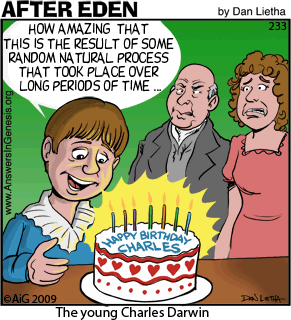
February 12, 2009. Today is the 200th anniversary of Abraham Lincoln's birthday. But that isn't the reason countless atheists and evolutionists around the world are celebrating today. Today is much more important than just the man who helps abolish American slavery. Today is also the 200th anniversary of Charles Darwin's birth.


2009 is also the 150th anniversary of Darwin's famous book "On the Origin of Species," and the secular culture is not letting us forget! Countless evolutionary organizations are promoting this day in hopes of making this a memorable day of atheistic evangelism. Some people are even calling today "Christmas for atheists." But this evangelism it isn't just limited to today. Many groups are making this entire year a year of praise for Darwinian orthodoxy. Museums (such as the Smithsonian) are opening new exhibits, TV specials are being shown, magazines published, and there are even parades, all in praise of the man who, according to Richard Dawkins, made it possible to be an "an intellectually fulfilled atheist." The religious determination of secular humanism and Darwin-worship (even billboards of praise) this year will no doubt be intimidating to many people, but as Christians this year represents something other than the promotion of evolutionary dogma. This year shows a unique opportunity for Christians around the world to present the Gospel message, and with even more urgency in the face of atheism.

Despite the fervent promotion of "Darwin Day," there are still many organizations who are celebrating God's creation as recorded in Genesis today, while pointing out the flaws of Darwin's theory. Just to quickly name a few:


As these articles and many more show, Christians have no reason to fear this year. We should not be discouraged by the militant fervor of some evolutionists, but rather should find courage and preach His word to the masses. Instead of making this a year of intellectual decay, let's make this a year of learning and growing spiritually by educating ourselves on the issues of the Creation/Evolution debate, and show the creation message "gently and respectfully" (1 Peter 3:15-16). You can do this in any number of ways, such as:

  1. Keeping up to date on the latest issues in creationism. Some groups have weekly articles featuring the latest Creation/Evolution news (such as AiG's weekly News to Note articles).
  2. Watching creation videos. These can be bought from almost any creationist organization. If you don't wish to purchase anything, there are also plenty of free video resources. AiG posts a new portion of one of their DVD's every week. Watching their talk "Origin of the Species: Was Darwin Right?" would be a great way to start educating yourself on Darwin's theory. CMI also has a "Creation Magazine Live!" feature. You could even borrow some videos from your local church!
  3. Tell your pastor/youth leader to visit The Creation Letter Project and sign the letter. I even encourage you to sign the letter and get involved!
  4. Find a group of people and friends and get involved! It could even be as simple as talking about current creation/evolution issues or even starting a mini Bible-study on Genesis and creation. Starting a small group is a great jumping-pad for actually talking to people about creationism vs. evolution. It is often easier to talk to someone when you have Godly friends to back you up.
  5. And most importantly, read the Bible. While creationists often stress the first book of the Bible, Genesis isn't the only place that talks about creation. Jesus Himself referred to Noah, as well as Adam and Eve.

Often it can be easy to get caught-up with the scientific aspects of the creation/evolution debate. We have to remember, though, that while the creation message is certainly important, it is not the true message of the Bible. The true message of the Bible is that the God of the universe became a man and died on the cross, bearing our sins. He then rose three days later, conquering death once and for all. And He offers life to all of us, if only we will trust Him to take away our sins as our Savior. What an amazing God we have, that he would die for us. This is what we are always trying to accomplish when learning and talking about creation: to always give glory to God.

Happy Trails,
Sam.

ICC '08 Update #3 (Wednesday, August 6)

Welcome readers to the final day of the ICC '08 coverage. It has been a long journey filled with late nights, quick food trips, and likely the most concentrated amount of creation science anywhere. This final ICC '08 coverage post will include more talk-overviews, more pictures, more interviews with great scientists, and once again... MORE! So without further adieu, let's jump headfirst into the Genesis vs Darwin Blog's last day covering the Sixth International Conference on Creationism!

Before we get to the session coverage, I would like to point out once again the diversity of creation organizations present at this conference. For instance, there were even two tables set up with creation materials in different languages. I have included a picture of some resources from one of the tables below.

The other non-English table at the conference was filled with mostly Spanish reseources


The first talk of the day was entitled "Significance of Highly Discordant Radioisotope Dates for Precambrian Amphibolites in Grand Canyon, USA" and was presented by Dr. Andrew Snelling. It outlined the area where they obtained samples and presented the obtained dates for rocks when different radiometric dating techniques were used. For instance, a rock was 405.1 ± 10 ma (ma = million years) using one technique, and 2574.2 ±73 ma using another dating technique. That's a difference of about 2169.1 ma depending upon what dating technique you use. Ironically, the evolutionary date of the formation is supposed to be 1740-1750 ma. What is the evolutionist to do when neither of the clearly untrustworthy dating techniques agree with their dates?

Yesterday, Andrew Snelling also gave two talks on radiohalos, their significance, and their evidence for the Flood. I was able to catch Dr. Snelling for a quick interview about his talks, as well as about a presentation he is giving tonight for the conference closing called "The Creation Model: Its Past, Its Present, and Its Necessary Future." (below, followed by a picture)

(if audio does not load go to direct link)
(to download: right-click direct link and "save as")


Andrew Snelling showing the results of some testing


I was also able to catch the very end of another talk at the same time entitled (once again, excuse the long name) "Analysis of Barry Hall's Research of the E. coli ebg Operon: Understanding the Implications for Bacterial Adaption to Adverse Environments" by Dr. Georgia Purdom. I wish I had heard more of this talk, as she talked about things such as Barry Hall's widely publicized research, as well as bacteria and their genes in different environments, etc. (picture below)


Georgia Purdom talks about adaptive mutations

At 10:15 I attended a talk by Dr. John Whitmore called "Rapid and Early Post-Flood Mammalian Diversification Evidenced in the Green River Formation." In the talk, they argued that the Green River Formation is a post-Flood deposit, rather than a Flood deposit, and also stressed the point that creationists need to agree upon parameters with which to decide when sediments were deposited. (picture below)

(left) Dr. John Whitmore talking about the Green River Formation
(right) Dr. Kurt Wise (co-writer of paper) took over for the Q&A session after the talk


You may remember that in the last update I said that I had one more interview to share with you. Last night I got an interview with geophysicist Dr. John Baumgardner after his talk entitled "The Roles of Tectonics and Rotational Dynamics in the Genesis Flood" (my favorite, and more informative talk of the conference). Below is the final interview of the Genesis vs Darwin Blog coverage of ICC '08! (below, followed by a picture)

(if audio does not load go to direct link)
(to download: right-click direct link and "save as")


A wide view of Dr. Baumgardner during his talk and the crowd

The Sixth International Conference on Creationism has been an amazing experience. Hearing the latest in creation research presented by the top scientists in various fields, and even meeting many of these people that I have either heard of, seen videos of, or read books by, has truly been out-of-this-world. As Mark Looy (CCO and Co-Founder of Answers in Genesis) said to me in a conversation earlier about ICC, "It's almost like going to Disney Land [for a creationist]" but without, I might add, the fantasy!

So there you have it! The 2008 International Conference on Creationism, presented as only the GvD Blog can present it! Check out the various organizations and scientists mentioned in the updates, and get educated! If you want to see all of the interviews in one place, visit http://genesisvsdarwin.mypodcast.com. You can even download them to iTunes and your iPod from there! It would only be proper to end the ICC '08 coverage with a picture of yours truly being eaten by a ferocious dinosaur at the conference! (below)


Oh yeah, and check back soon for more posts on the GvD Blog!

Happy Trails,
GvD Sam

Creation Paper- Did Horses Really Evolve?

GvD Christie
Did Horses Really Evolve?

There is a deep conflict between evolutionists and creationists. Scientists on both “sides” frequently debate the truth of Charles Darwin’s evolutionary theory. Darwin was made famous by his popularizing of evolution in his two most-popular books, On the Origin of Species and The Descent of Man.

Although creationists are frequently portrayed as a powerless, obsessive minority, most of the great scientific minds of history have been Bible-believing Christians who believed that their faith made their scientific studies not just better, but possible. Such is the case with Sir Isaac Newton, Johannes Kepler, Francis Bacon, and many others who were all devout Christians. Creationists merely claim that the God of Christianity created the Earth, rather than the undirected, random processes of the Big Bang (or other evolutionary origin theories).

Evolution claims that horses, like everything else in this world, evolved over millions of years through chance processes from a common ancestor. On the other hand, creationists claim that animals were created in separate “kinds” (read the first chapter of Genesis). Creationists postulate that natural selection and mutation can produce varieties within these original kinds, but never turn an animal into a different kind (as evolution requires).

A common evolutionary propaganda idea is the "horse series." The famed horse series, allegedly showing the process of the evolution of the horse, has been proven wrong by new discoveries in science. Nevertheless, it is still presented as fact in many evolutionary resources. But first let's look more into the history of the horse fossils contained in the series.

In 1841, paleontologist Richard Owen found a fossil. He dubbed it Hyracotherium because of its similarity to the hyrax, or rock badger. Owen did not see any relation to the horse upon his first examination. Nevertheless, two scientists, O.C. Marsh and T.H. Huxley, decided to rename the discovery Eohippus after noting supposed evolutionary similarities to the modern horse (Sarfati, n.p.). Eohippus had the teeth of an omnivore, was about the size of a large dog, and had multiple toes – four in the front, three in the back.

And from that first discovery of Eohippus came the rest of the famed tree of horse evolution, frequently used as an excellent example and “proof” of the evolution. In this evolutionary tree, Mesohippus follows Eohippus, appearing suddenly about 15 million years later, with a “vestigial” fourth toe in the front legs. About 17 million years ago, the evolutionary model says, came Merychippus. It had evolved longer legs, better suited for running (like the modern horse) and had only three toes (Hunt, n.p.).

This “clear-cut tree,” as it is described in many textbooks, is now said to be more reminiscent of an indistinguishable bush, showing no progression of evolution. Nevertheless, this diagram even appears in the famous Smithsonian Museum – and yet there are numerous problems with it!

First of all, there are no “transitional” species between the three previously mentioned fossils. There is only sudden, abrupt change. If the evolutionary theory was true, one would expect to find multiple fossils showing the slow disappearance of toes and lengthening of legs. Even more problematic is the fact that there is no way for the evolutionist to describe how the change took place. Quite literally, all that is said is that these early horses “gave rise” to later horses (Hunt, n.p.), but there is no explanation of how this occurred.

Supposed “vestigial” organs are frequently cited as another example of evolution. Toes that were on previous horses and remain on later ones, but are “useless,” supposedly proves how horses changed. However, not all evolutionists agree with this view – in fact, the evolutionary zoologist S.R. Scadding has even said, “vestigial organs provide no evidence for evolutionary theory.” (Sarfati, n.p.).

This is due to two main reasons. First, it often happens that a part of an animal is deemed vestigial, only later to have a use found; just because the use of an organ is unknown does not automatically mean it has no use. Secondly, vestigial organs, if anything, prove de-volution rather than evolution – vestigial organs would show a loss of information because the organ is no longer working, rather than the increase of information as required by evolution. (Batten, n.p.) In the case of the horse, especially, vestigial limbs cannot be proof. For instance, the splint bone, which was supposed to be vestigial (Hunt, n.p.), does indeed have a function: it protects the extremely important suspensory ligament and helps support the horse’s slender legs while galloping. (Sarfati, n.p.)

Even if fossil horses have different numbers of toes, or are different sizes, there is no reason to assert that there was an evolutionary sequence between them. Even today, there have been horses in the Southwestern part of the United States that have multiple toes similar to the fossilized Pliohippus. The genes for the multiple toes are still there, just usually hidden. (Sarfati, n.p.)

Today, there are many variations on the general horse “kind” – there is the massive Clydesdale, the well-known draft horse that pulls the Budweiser wagon; and there is the miniscule Miniature Horse, which can be as few as eighteen inches tall. (Sarfati, n.p.) Looking at these two side by side, it is true that they look very different – but nevertheless, each is still a horse. Just like the fossilized horses unearthed, some living horses are very small and some are very tall.

Despite the undisputed differences between these now extinct horses and the modern horses, it can easily be argued that the former are merely variations on today’s horse kind. The supposed vestigial organs of the horse, which were thought to prove its evolution, are not evidence for evolution, and further, horses have no useless organs. And yet, the evolution of the horse is still taught in schools today as truth! Whether you believe evolution occurred or not depends on your worldview and how you interpret the facts. However, the scientific evidence fits more easily in a Biblical worldview rather than an evolutionary worldview.


God Bless,

GvD Christie


Works Cited

-*- Batten, Dr. Don, and Dr. Jonathan Sarfati. “’Vestigial’ Organs: What Do They Prove?” 10 April 2008.

-*- Hunt, Kathleen. “Horse Evolution.” TalkOrigins Jan. 4, 1995. 8 April 2008.

-*- Menton, David N., Ph.D. “The Human Tail, and other Tales of Evolution.” 1997. Missouri Association for Creation. 19 April 2008.

-*- Sarfati, Jonathan. “The non-evolution of the horse.” Creation Volume 21. June 1999 on Answers in Genesis. 8 April 2008.