Evolution and Culture (Part One)


Evolution is one of the most widely accepted beliefs in our school systems today. It permeates our textbooks and is hammered into our minds as fact in almost every science classroom across the nation. How many times have you opened a science book and the first thing you read is something to the effect of "about 4.5 billion years ago…" or "the universe has changed since its conception over 10 billion years ago"?

The theory is taught as a one-sided truth, leaving no room in the students’ mind for question or doubt. It all makes sense, doesn’t it? They are scientists, after all. They can't be biased, can they? They know what they’re talking about, don’t they? Well, it wouldn’t be the first time secular humanism was wrong.

The point of these next few posts is to reveal to the reader the unspoken truths and evidences that evolutionists refuse to reveal on a large scale. It will also expose some of the flaws in the theory of evolution and demonstrate how evidence can be used to support creation.

The theory of evolution is a problem not only for adults and college students, but also for children from their very first year of school. Part of the reason many students today believe in evolution is because they have been taught it as fact since they first walked through school doors. Innocent first graders will believe almost anything you tell them. So, without any other influence, of course they will believe in evolution. Especially when they open their textbooks and the first thing they read is: "Earth has changed much since its formation 4.5 billion years ago. Some life on earth has adapted to these changes." (First Grade Merrill Science, 1989 p. 46) Then again, in second grade, students are taught the theory as an "obvious fact," almost in an attempt to make anyone who believes differently look uneducated.

This tactic has become more widely used by evolutionists in the last decade. Whereas before you could find many public debates between evolutionists and creationists, most atheists today are content to stay locked in their houses and mock creationists from afar. This is what is becoming known as a sort of "New Atheism," being spearheaded by Richard Dawkins, Christopher Hitchens, and those like them. Through them, the call of atheism has turned into a war-cry. They have entered a phase of radical evangelism, calling not only for the institution of their own religion, but the eradication of all others.

This has led to a very negative climate, where any dissension from Darwinism is not permitted. While the Bible tells us that Christians will face persecution (Mark 13:13, Matthew 5:10–12), the amount, and frequency that Christians are persecuted in science is greater now than ever thanks to this "New Atheism." The fact is, the current climate is not neutral. Just turn on the news or the Discovery Channel to see this as fact. Many of you who have stood up for your faith may have experienced similar things.


To be continued in Part Two...

Happy Trails,
Sam.

Creation Paper- Did Horses Really Evolve?

GvD Christie
Did Horses Really Evolve?

There is a deep conflict between evolutionists and creationists. Scientists on both “sides” frequently debate the truth of Charles Darwin’s evolutionary theory. Darwin was made famous by his popularizing of evolution in his two most-popular books, On the Origin of Species and The Descent of Man.

Although creationists are frequently portrayed as a powerless, obsessive minority, most of the great scientific minds of history have been Bible-believing Christians who believed that their faith made their scientific studies not just better, but possible. Such is the case with Sir Isaac Newton, Johannes Kepler, Francis Bacon, and many others who were all devout Christians. Creationists merely claim that the God of Christianity created the Earth, rather than the undirected, random processes of the Big Bang (or other evolutionary origin theories).

Evolution claims that horses, like everything else in this world, evolved over millions of years through chance processes from a common ancestor. On the other hand, creationists claim that animals were created in separate “kinds” (read the first chapter of Genesis). Creationists postulate that natural selection and mutation can produce varieties within these original kinds, but never turn an animal into a different kind (as evolution requires).

A common evolutionary propaganda idea is the "horse series." The famed horse series, allegedly showing the process of the evolution of the horse, has been proven wrong by new discoveries in science. Nevertheless, it is still presented as fact in many evolutionary resources. But first let's look more into the history of the horse fossils contained in the series.

In 1841, paleontologist Richard Owen found a fossil. He dubbed it Hyracotherium because of its similarity to the hyrax, or rock badger. Owen did not see any relation to the horse upon his first examination. Nevertheless, two scientists, O.C. Marsh and T.H. Huxley, decided to rename the discovery Eohippus after noting supposed evolutionary similarities to the modern horse (Sarfati, n.p.). Eohippus had the teeth of an omnivore, was about the size of a large dog, and had multiple toes – four in the front, three in the back.

And from that first discovery of Eohippus came the rest of the famed tree of horse evolution, frequently used as an excellent example and “proof” of the evolution. In this evolutionary tree, Mesohippus follows Eohippus, appearing suddenly about 15 million years later, with a “vestigial” fourth toe in the front legs. About 17 million years ago, the evolutionary model says, came Merychippus. It had evolved longer legs, better suited for running (like the modern horse) and had only three toes (Hunt, n.p.).

This “clear-cut tree,” as it is described in many textbooks, is now said to be more reminiscent of an indistinguishable bush, showing no progression of evolution. Nevertheless, this diagram even appears in the famous Smithsonian Museum – and yet there are numerous problems with it!

First of all, there are no “transitional” species between the three previously mentioned fossils. There is only sudden, abrupt change. If the evolutionary theory was true, one would expect to find multiple fossils showing the slow disappearance of toes and lengthening of legs. Even more problematic is the fact that there is no way for the evolutionist to describe how the change took place. Quite literally, all that is said is that these early horses “gave rise” to later horses (Hunt, n.p.), but there is no explanation of how this occurred.

Supposed “vestigial” organs are frequently cited as another example of evolution. Toes that were on previous horses and remain on later ones, but are “useless,” supposedly proves how horses changed. However, not all evolutionists agree with this view – in fact, the evolutionary zoologist S.R. Scadding has even said, “vestigial organs provide no evidence for evolutionary theory.” (Sarfati, n.p.).

This is due to two main reasons. First, it often happens that a part of an animal is deemed vestigial, only later to have a use found; just because the use of an organ is unknown does not automatically mean it has no use. Secondly, vestigial organs, if anything, prove de-volution rather than evolution – vestigial organs would show a loss of information because the organ is no longer working, rather than the increase of information as required by evolution. (Batten, n.p.) In the case of the horse, especially, vestigial limbs cannot be proof. For instance, the splint bone, which was supposed to be vestigial (Hunt, n.p.), does indeed have a function: it protects the extremely important suspensory ligament and helps support the horse’s slender legs while galloping. (Sarfati, n.p.)

Even if fossil horses have different numbers of toes, or are different sizes, there is no reason to assert that there was an evolutionary sequence between them. Even today, there have been horses in the Southwestern part of the United States that have multiple toes similar to the fossilized Pliohippus. The genes for the multiple toes are still there, just usually hidden. (Sarfati, n.p.)

Today, there are many variations on the general horse “kind” – there is the massive Clydesdale, the well-known draft horse that pulls the Budweiser wagon; and there is the miniscule Miniature Horse, which can be as few as eighteen inches tall. (Sarfati, n.p.) Looking at these two side by side, it is true that they look very different – but nevertheless, each is still a horse. Just like the fossilized horses unearthed, some living horses are very small and some are very tall.

Despite the undisputed differences between these now extinct horses and the modern horses, it can easily be argued that the former are merely variations on today’s horse kind. The supposed vestigial organs of the horse, which were thought to prove its evolution, are not evidence for evolution, and further, horses have no useless organs. And yet, the evolution of the horse is still taught in schools today as truth! Whether you believe evolution occurred or not depends on your worldview and how you interpret the facts. However, the scientific evidence fits more easily in a Biblical worldview rather than an evolutionary worldview.


God Bless,

GvD Christie


Works Cited

-*- Batten, Dr. Don, and Dr. Jonathan Sarfati. “’Vestigial’ Organs: What Do They Prove?” 10 April 2008.

-*- Hunt, Kathleen. “Horse Evolution.” TalkOrigins Jan. 4, 1995. 8 April 2008.

-*- Menton, David N., Ph.D. “The Human Tail, and other Tales of Evolution.” 1997. Missouri Association for Creation. 19 April 2008.

-*- Sarfati, Jonathan. “The non-evolution of the horse.” Creation Volume 21. June 1999 on Answers in Genesis. 8 April 2008.


The Horizon Problem - The Monopole Problem – GvD - Issue 2 - Big Bang vs Big God (Section Two)


The Horizon Problem


Many people point out the "light travel-time problem" in the Creationist worldview, yet don't know that the Big Bang has a light travel-time problem of its own. This, perhaps more than anything, is the reason why the Cosmic Microwave Background Radiation (CMB, see last issue for more information) is no help for the Big Bang theorist. To get set up, let's have a quick review of the CMB. The CMB is an extremely uniform microwave radiation at about 2.7 Kelvin that is present everywhere in the known universe.

Assuming the Big Bang, the temperature of the CMB would have been very different throughout the universe early in its existence due to the Big Bang's initial conditions. But how would these areas come to temperature equilibrium as we see in the CMB today? Well, areas that were in close contact would come to the same temperature relatively quickly. More distant regions of space would come to temperature equilibrium through radiation transfer (light). Light would carry the energy from warmer regions of space to the colder ones until each reached equilibrium, thus creating the observed CMB. So what is the problem?

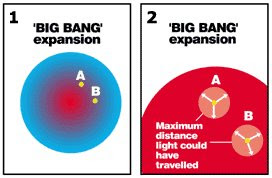
Even given the Big Bang time scale of billions and billions of years, there has not been enough time for light to traverse the vast reaches of space from one edge of the universe to the other and exchange heat. Yet, everywhere we look in the cosmos, we see the incredibly uniform CMB temperature of 2.7 Kelvin. While the Big Bang's time scale allows for light from the distant galaxies to earth, it does not allow for the light from distant galaxies to travel from one edge of the visible universe to the other and exchange heat. Therefore the CMB could not be the same temperature everywhere. Yet, it is. Below is a commonly used simple illustration of the problem.


Frame 1) Points A and B would be at very different temperatures near the beginning of the Big Bang.
Frame 2) In the present, both points A and B have the same temperature, though not enough time has elapsed for them to have exchanged light.


This is essentially a light travel-time problem. It is a temperature problem, but due to light travel-time. There has not been enough time, even in the Big Bang model, for light to travel the entire distance of the universe to make the CMB uniform. Thus, Big Bangers shouldn't use the "distant starlight problem" in an effort to discredit Scripture when their own assertion has the same problem. Both the Big Bang and Creation theories need light to get somewhere faster than it can as measured by today's standards. But does either side have an explanation? This will be discussed later.


The Monopole Problem

Another big problem for the Big Bang is the Monopole Problem. But what are monopoles? Well, in physics, there are particles that have only a positive or negative charge (ex. electrons are only negative, protons are only positive). In that same way, magnets have north and south poles, which are called magnetic monopoles.
At hot enough temperatures (such as in the Big Bang), physics says magnetic monopoles should be created. Yet, not one monopole has been found. Following this observation, it suggests that the universe was never as hot as the Big Bang model asserts. The Big Bang model desperately needs to explain how light can traverse such distances in such a short time, as well as explain an apparent lack of monopoles. Does it offer such an explanation, or simply another set of assumptions? This will be discussed in the next post.

GvD Blog – The Enlightened Post

Sadly for most of us, the school year is underway. Our minds have been forced out of hibernation and back into backpacks and lockers stuffed with homework.

Many of us are already taking classes such as World History or US History. Lately in these classes, as well as in English, we have been learning a lot about the so-called "Enlightenment" and its effects on society. From this stems the point of this post…

This week we learned that Enlightenment thinkers (like Voltaire, Diderot, and Gibbon) taught that true science required the defeat of religion. Okay, no surprise there. As the Enlightenment thinkers were almost entirely ardent atheists and humanists, it is no surprise that they strongly disliked religion.

While learning about the "Enlightenment," I have found that many people have the wrong idea about what happened and its implications on religion. Many people have the idea that Enlightenment thinkers disproved religion in favor of reason and science. This is not the case at all.

I was VERY surprised to learn, though, that scientists like Galileo, Isaac Newton, and Francis Bacon showed that you could believe in natural laws and observation rather than God and religion. I must admit, when I first heard my history and English teachers say this, I was a bit puzzled. Perhaps they, as well as some of you, are unaware that these scientists were devout Christians. These scientists did not prove that you could believe in natural laws rather than God, but rather that natural laws came directly from God. For these men, natural laws were proof that God existed, proof of order in the universe.

Some of you may be skeptical that these men were devout Christians.


Many of us have heard of the "Galileo Controversy" in which the church officially censored his teaching of the heliocentric model. The church as an entirety, though, was not against his views, as many of us have simply assumed from this censorship. In fact, many church officials regarded his view well. Even through all of this, he still believed the Bible and that it supported his views. For more information on the "Galileo Controversy" see: The Galileo affair: history or heroic hagiography?


Sir Francis Bacon is credited with establishing the "scientific method" and helping to found the Royal Society of London. How could he be a devout Christian? Let's read a quote from Bacon:

"There are two books laid before us to study, to prevent our falling into error; first, the volume of the Scriptures, which reveal the will of God; then the volume of the Creatures, which express His power"

He was a devout believer in the Bible. He believed that the scientific method is the observation and study of God's world and the natural laws He uses to govern it.


Surely Sir Isaac Newton, being one of the greatest scientific minds to ever live, should know better than to believe in God. Perhaps you will be surprised by the astonishing fact that he wrote more about the Bible than he did about science. His belief that science leads to a greater understanding of God shaped his entire life. In his book Principia, he wrote:

"This most beautiful system of the sun, planets, and comets, could only proceed from the counsel and dominion of an intelligent Being. … This Being governs all things, not as the soul of the world, but as Lord over all; and on account of his dominion he is wont to be called "Lord God"… or "Universal Ruler". … The Supreme God is a Being eternal, infinite, absolutely perfect."

  • Principia, Book III; cited in Newton's Philosophy of Nature: Selections from his writings, p. 42.

So did Sir Isaac Newton prove that God is not necessary? No, in fact exactly the opposite; he believed that investigation and natural laws helped in the understanding of how God upholds the universe. In fact, Newton was strongly against atheism:

"Opposition to godliness is atheism in profession and idolatry in practice. Atheism is so senseless and odious to mankind that it never had many professors"

  • A Short Scheme of the True Religion, manuscript quoted in Memoirs of the Life, Writings and Discoveries of Sir Isaac Newton by Sir David Brewster; cited in Newton's Philosophy of Nature, p. 65, Ref. 2.

Even today, we find manuscripts proving over and over Newton's religious fervor. In fact it appears from his writing that he was especially interested in the book of Daniel in the Bible (see Papers reveal Newton's religious side, USA Today). For more information on Sir Isaac Newton and his belief in the Creator God, see Sir Isaac Newton (1642/3–1727).

So was Voltaire right when he taught that science required the defeat of religion? Perhaps he needs to read-up on his history, as virtually every branch of science was started by a devout Christian (i.e. Francis Bacon, Galileo Galilei, Johann Kepler, Isaac Newton, Carolus Linnaeus, etc). Also, the overwhelming majority of sixteenth and seventeenth century scientific leaders were Christians who believed it science's duty to comprehend the Bible. Through my searching, the best list of Christian (creation) scientists is located here: Creation scientists and other biographies of interest.


We shall end this post with a statement from the USA Today article mentioned above:

'The Newton papers, Ben-Menahem said, also complicate the idea that science is diametrically opposed to religion. "These documents show a scientist guided by religious fervor, by a desire to see God's actions in the world," she said.'


Until the next post and the next newsletter issue,

Happy Trails,

Sam