

 Posts
Posts


ICC '08 Update #3 (Wednesday, August 6)
Welcome readers to the final day of the ICC '08 coverage. It has been a long journey filled with late nights, quick food trips, and likely the most concentrated amount of creation science anywhere. This final ICC '08 coverage post will include more talk-overviews, more pictures, more interviews with great scientists, and once again... MORE! So without further adieu, let's jump headfirst into the Genesis vs Darwin Blog's last day covering the Sixth International Conference on Creationism!
Before we get to the session coverage, I would like to point out once again the diversity of creation organizations present at this conference. For instance, there were even two tables set up with creation materials in different languages. I have included a picture of some resources from one of the tables below.
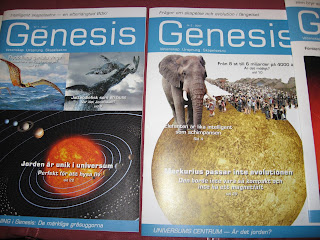 The other non-English table at the conference was filled with mostly Spanish reseources
The first talk of the day was entitled "Significance of Highly Discordant Radioisotope Dates for Precambrian Amphibolites in Grand Canyon, USA" and was presented by Dr. Andrew Snelling. It outlined the area where they obtained samples and presented the obtained dates for rocks when different radiometric dating techniques were used. For instance, a rock was 405.1 ± 10 ma (ma = million years) using one technique, and 2574.2 ±73 ma using another dating technique. That's a difference of about 2169.1 ma depending upon what dating technique you use. Ironically, the evolutionary date of the formation is supposed to be 1740-1750 ma. What is the evolutionist to do when neither of the clearly untrustworthy dating techniques agree with their dates?
Yesterday, Andrew Snelling also gave two talks on radiohalos, their significance, and their evidence for the Flood. I was able to catch Dr. Snelling for a quick interview about his talks, as well as about a presentation he is giving tonight for the conference closing called "The Creation Model: Its Past, Its Present, and Its Necessary Future." (below, followed by a picture)
(if audio does not load go to direct link)
(to download: right-click direct link and "save as")
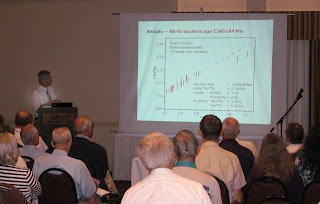 Andrew Snelling showing the results of some testing
I was also able to catch the very end of another talk at the same time entitled (once again, excuse the long name) "Analysis of Barry Hall's Research of the E. coli ebg Operon: Understanding the Implications for Bacterial Adaption to Adverse Environments" by Dr. Georgia Purdom. I wish I had heard more of this talk, as she talked about things such as Barry Hall's widely publicized research, as well as bacteria and their genes in different environments, etc. (picture below)
 Georgia Purdom talks about adaptive mutations
Before we get to the session coverage, I would like to point out once again the diversity of creation organizations present at this conference. For instance, there were even two tables set up with creation materials in different languages. I have included a picture of some resources from one of the tables below.
 The other non-English table at the conference was filled with mostly Spanish reseources
The first talk of the day was entitled "Significance of Highly Discordant Radioisotope Dates for Precambrian Amphibolites in Grand Canyon, USA" and was presented by Dr. Andrew Snelling. It outlined the area where they obtained samples and presented the obtained dates for rocks when different radiometric dating techniques were used. For instance, a rock was 405.1 ± 10 ma (ma = million years) using one technique, and 2574.2 ±73 ma using another dating technique. That's a difference of about 2169.1 ma depending upon what dating technique you use. Ironically, the evolutionary date of the formation is supposed to be 1740-1750 ma. What is the evolutionist to do when neither of the clearly untrustworthy dating techniques agree with their dates?
Yesterday, Andrew Snelling also gave two talks on radiohalos, their significance, and their evidence for the Flood. I was able to catch Dr. Snelling for a quick interview about his talks, as well as about a presentation he is giving tonight for the conference closing called "The Creation Model: Its Past, Its Present, and Its Necessary Future." (below, followed by a picture)
(if audio does not load go to direct link)
(to download: right-click direct link and "save as")
 Andrew Snelling showing the results of some testing
 Georgia Purdom talks about adaptive mutations
At 10:15 I attended a talk by Dr. John Whitmore called "Rapid and Early Post-Flood Mammalian Diversification Evidenced in the Green River Formation." In the talk, they argued that the Green River Formation is a post-Flood deposit, rather than a Flood deposit, and also stressed the point that creationists need to agree upon parameters with which to decide when sediments were deposited. (picture below)
 (left) Dr. John Whitmore talking about the Green River Formation
(right) Dr. Kurt Wise (co-writer of paper) took over for the Q&A session after the talk
 (left) Dr. John Whitmore talking about the Green River Formation
(right) Dr. Kurt Wise (co-writer of paper) took over for the Q&A session after the talk
You may remember that in the last update I said that I had one more interview to share with you. Last night I got an interview with geophysicist Dr. John Baumgardner after his talk entitled "The Roles of Tectonics and Rotational Dynamics in the Genesis Flood" (my favorite, and more informative talk of the conference). Below is the final interview of the Genesis vs Darwin Blog coverage of ICC '08! (below, followed by a picture)
(if audio does not load go to direct link)
(to download: right-click direct link and "save as")
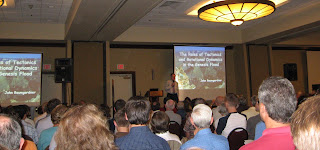 A wide view of Dr. Baumgardner during his talk and the crowd
The Sixth International Conference on Creationism has been an amazing experience. Hearing the latest in creation research presented by the top scientists in various fields, and even meeting many of these people that I have either heard of, seen videos of, or read books by, has truly been out-of-this-world. As Mark Looy (CCO and Co-Founder of Answers in Genesis) said to me in a conversation earlier about ICC, "It's almost like going to Disney Land [for a creationist]" but without, I might add, the fantasy!
So there you have it! The 2008 International Conference on Creationism, presented as only the GvD Blog can present it! Check out the various organizations and scientists mentioned in the updates, and get educated! If you want to see all of the interviews in one place, visit http://genesisvsdarwin.mypodcast.com. You can even download them to iTunes and your iPod from there! It would only be proper to end the ICC '08 coverage with a picture of yours truly being eaten by a ferocious dinosaur at the conference! (below)

Oh yeah, and check back soon for more posts on the GvD Blog!
Happy Trails,
GvD Sam
(if audio does not load go to direct link)
(to download: right-click direct link and "save as")
 A wide view of Dr. Baumgardner during his talk and the crowd
The Sixth International Conference on Creationism has been an amazing experience. Hearing the latest in creation research presented by the top scientists in various fields, and even meeting many of these people that I have either heard of, seen videos of, or read books by, has truly been out-of-this-world. As Mark Looy (CCO and Co-Founder of Answers in Genesis) said to me in a conversation earlier about ICC, "It's almost like going to Disney Land [for a creationist]" but without, I might add, the fantasy!
So there you have it! The 2008 International Conference on Creationism, presented as only the GvD Blog can present it! Check out the various organizations and scientists mentioned in the updates, and get educated! If you want to see all of the interviews in one place, visit http://genesisvsdarwin.mypodcast.com. You can even download them to iTunes and your iPod from there! It would only be proper to end the ICC '08 coverage with a picture of yours truly being eaten by a ferocious dinosaur at the conference! (below)

Oh yeah, and check back soon for more posts on the GvD Blog!
Happy Trails,
GvD Sam


